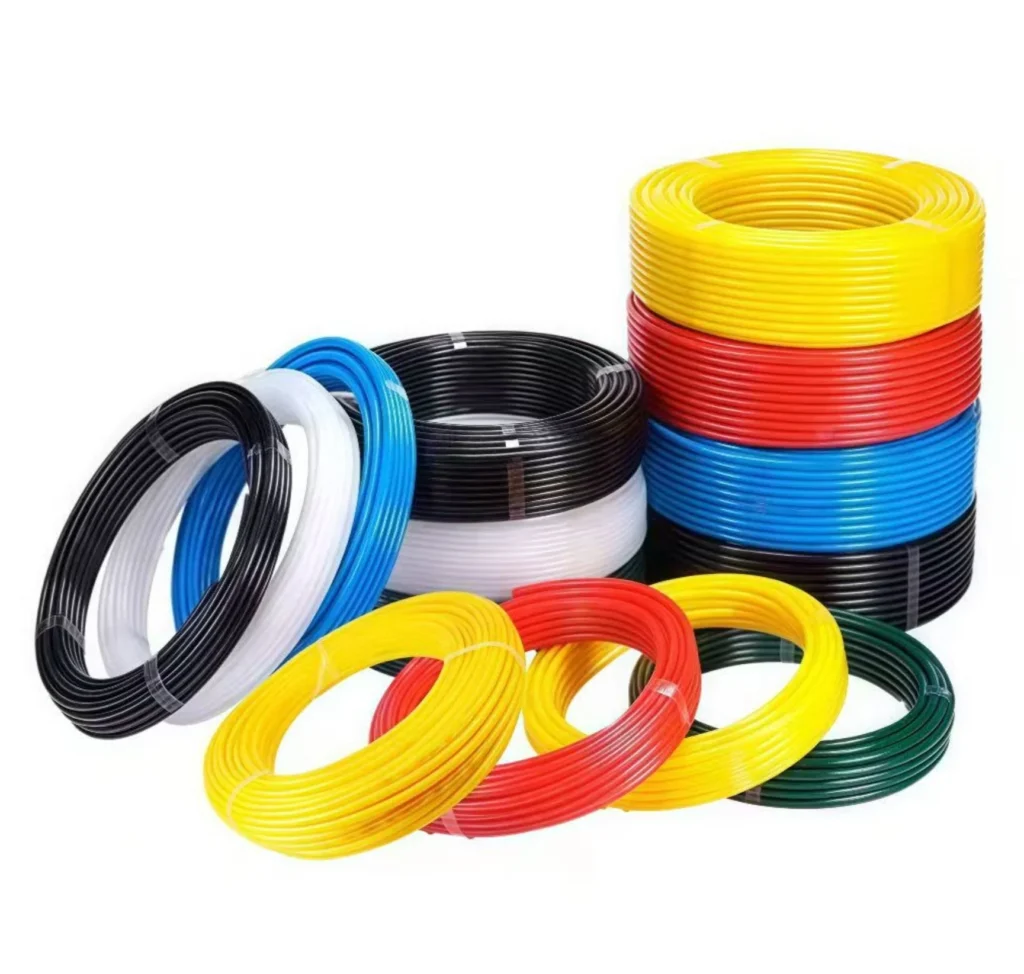
Choosing the right tubing for your truck’s air system isn’t just about price—it’s about safety and compliance. At Aoke Auto Parts, we often see customers confused by the differences between Nylon (PA12), Polyurethane (PU), and Polyethylene (PE).
Which one is DOT approved? Which one handles the cold best? Can you use PE for brakes? In this technical guide, our engineering team answers the top 20 questions about pneumatic tubing to help you make the right choice for your fleet.
🟢 Part 1: Material Differences (Nylon vs. PU vs. PE)
Understanding the pros and cons of each material is the first step.
Q1: What are the main differences between Nylon, PU, and PE tubing?
- Nylon (PA12): The industry standard for air brakes. It offers high pressure resistance, durability, and chemical resistance.
- PU (Polyurethane): Extremely flexible and kink-resistant. Great for tight spaces and pneumatic tools, but has lower pressure ratings than Nylon.
- PE (Polyethylene): The most cost-effective option. Best for low-pressure fluid transfer or instrumentation. Not for air brakes.
Q2: Which tubing is best for air brake systems? Nylon tubing (specifically PA12) is the preferred and safest choice for air brake systems, suspension, and auxiliary systems. It balances rigidity with flexibility and meets safety standards.
Q3: Can PE tubing be used for air brakes? No. PE tubing is strictly not suitable for high-pressure braking systems. It lacks the heat resistance and burst pressure strength required for road safety.
Q4: Is PU tubing more flexible than Nylon? Yes. PU is significantly more flexible and has better vibration resistance than rigid Nylon. This makes it ideal for moving parts or tight bends inside the cab, but always check the pressure rating before use.
Q5: What is “Multi-layer Tubing”? This refers to tubing constructed with reinforced layers (often fiber braids between layers of Nylon or rubber) to provide added strength and higher burst pressure ratings compared to standard single-wall tubing.
🔵 Part 2: Safety, Pressure & Temperature (DOT Standards)
Compliance is non-negotiable for heavy-duty trucks.
Q6: Is Nylon tubing DOT approved? Yes, but only when manufactured to specific standards. Look for printing on the tube that says “DOT” or “SAE J844”. Aoke’s Nylon tubing is fully compliant.
Q7: Can Nylon tubing be used for ABS/EBS systems? Yes. DOT-approved Nylon tubing is standard for ABS (Anti-lock Braking Systems) and EBS configurations due to its reliable signal transmission consistency.
Q8: What pressure can Nylon tubing handle? It typically handles working pressures between 150 PSI and 300 PSI, depending on the wall thickness and outer diameter (O.D.). Always check the spec sheet.
Q9: What temperature range does Nylon tubing handle? Quality Nylon (PA12) performs well from -40°C to +100°C. This is crucial for trucks operating in freezing winters or hot summers.
🟠 Part 3: Selection & Customization
How to choose the right spec for your application.
Q10: How do I choose the correct tubing size? Selection should be based on three factors:
- Airflow Demand: Larger brakes need more air (larger I.D.).
- Fitting Size: Must match your push-to-connect or compression fittings.
- System Pressure: Ensure the wall thickness can handle your max PSI.
Q11: Is color-coded tubing required? While not strictly “required” by law for every inch, it is highly recommended for safety and maintenance:
- Blue: Service lines.
- Red: Emergency lines.
- Black/Green: Auxiliary or electrical protection.
🟣 Part 4: Installation, Cutting & Maintenance
Prevent leaks and extend the life of your air lines.
Q12: How do I cut Nylon tubing correctly? Crucial Step: Always use a sharp tubing cutter to ensure a perfectly square (90-degree), clean cut. Never use pliers or side cutters, as they crush the tube into an oval shape, causing leaks.
Q13: Are push-to-connect fittings compatible? Yes. Nylon and PU work well with push-to-connect fittings.
- Tip: Ensure the tube is inserted fully until it hits the internal stop to engage the seal.
Q14: How do I prevent leaks?
- Ensure a square cut (see Q12).
- Do not over-tighten compression fittings (this cracks the tube).
- Ensure the tube surface is smooth and not scratched where it meets the O-ring.
Q15: Can Nylon tubing be bent? Yes, but be careful. Every tube has a “Minimum Bend Radius.” If you bend it tighter than this radius, it will kink and restrict airflow.
Q16: Why does Nylon tubing crack over time? Three main reasons:
- UV Exposure: Sunlight makes plastic brittle over years.
- Chemical Contact: Road salts, battery acid, or harsh cleaners.
- Aging: Natural material degradation.
Q17: How long does Nylon tubing last? In normal operating conditions, high-quality PA12 tubing typically lasts 5–10 years.
Q18: Is PU tubing better for vibration? Yes. Because it is softer, PU absorbs vibration better than rigid Nylon, making it less prone to cracking near engine mounts or vibrating machinery.
Q19: Can tubing be reused? Generally No. Once a compression ring has “bitten” into the tube, or a push-fitting’s teeth have marked it, reusing the end increases leak risks. It’s safer to cut off the used end and start fresh.
🚀 Conclusion: Factory Direct Quality
Don’t risk your fleet’s safety with inferior materials. Whether you need rigid DOT-Approved Nylon Tubing for braking or flexible PU Tubing for auxiliary systems, Aoke Auto Parts manufactures them to the highest ISO standards.
👉 [Browse Our Air Brake Tubing Catalog] or [Contact Us for a Quote]


